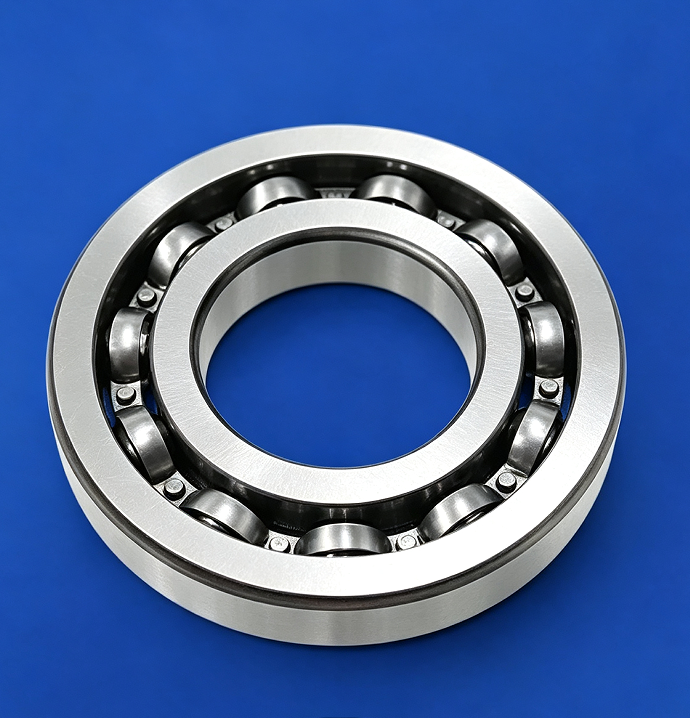
Features, Applications and Common Failure Causes of Deep Groove Ball Bearings
Date:
Deep groove ball bearings are the most widely circulated, versatile, yet also most prone-to-damage bearing type. This article clarifies the installation taboos and common failure causes of deep groove ball bearings.
1. How to Identify Deep Groove Ball Bearing Models
Take the commonly used 6205 as an example. Each digit in the model carries a specific meaning:
First digit 6: Standard industry code for deep groove ball bearings.
Second digit 2: Size series, indicating the bearing’s width and thickness. A larger number means a larger dimension and higher load capacity. Series 2 is the most common type on the market.
Last two digits 05: Bore size. Following the universal industry rule, multiply by 5. Code 05 corresponds to 25 mm, which makes shaft matching convenient.
Suffix Explanations
ZZ: Double metal shields. Dust-proof only, not water-resistant; no contact friction inside.
2RS: Double rubber seals. Fully enclosed protection against dust, water and oil contamination.
Z1, Z2: Vibration grades for electric motors. Z2 has higher precision and lower operating vibration, suitable for motors running continuously for long hours.
2. Operating Characteristics of Deep Groove Ball Bearings
Deep groove ball bearings feature a simple overall structure, low rotational resistance, high limiting speed, stable operation and low noise. Routine frequent maintenance is generally unnecessary.
Shielded (metal cover) versions deliver good heat dissipation and smooth rotation, and are less likely to overheat during prolonged high-speed operation.
Sealed (rubber cover) versions offer superior protection and withstand harsh conditions such as dust and moisture. Their only downside is friction from the seals, making them unsuitable for sustained ultra-high-speed operation.
3. Load Capacity Range
Deep groove ball bearings are designed primarily for radial loads, such as vertical pressure from equipment self-weight and belt tension. They shall not be used on equipment subject to heavy axial push-pull force, as this will lead to premature failure.
Load is borne by point contact of steel balls, so the load capacity is limited. These bearings cannot withstand heavy static loads or violent impacts, so they are not suitable for mining vibrating machinery and heavy impact equipment.
4. Suitable Application Scenarios
Deep groove ball bearings with metal shields: Both ends of industrial motors, fans, clean water pumps, air compressors and non-stop running equipment.
Deep groove ball bearings with rubber seals: Agricultural machinery, conveyor idlers, woodworking machinery, equipment in dusty workshops and outdoor humid environments.
⚠️ Note for avoidance: Not recommended for vibrating machinery, heavy-duty reducers and transmission positions subjected to large axial loads.
5. Practical Operation Tips
For equipment working under persistent high temperatures, select deep groove ball bearings with increased clearance to prevent seizure caused by thermal expansion.
Do not mix new and old bearings on the same shaft. Misalignment will easily trigger vibration and failure.
The temperature of normally running deep groove ball bearings should stay below 70℃. Shut down the machine promptly for inspection if the bearing feels hot to touch.
Do not overfill lubricating grease. One-third filling volume is optimal. Excessive grease is a major cause of overheating.
6. On-site Installation Key Points
When installing deep groove ball bearings, impact force shall only be applied to the inner ring. Never strike the outer ring. Damage to the raceways will easily lead to abnormal noise and premature failure later.
Remove burrs on the shaft journal before installation. Forcible pressing is prohibited.
For motor bearings requiring high precision, adopt hot mounting. Keep the heating temperature between 80℃ and 110℃. Avoid excessive temperature which may cause annealing and damage the material.
Note: After full installation, rotate the shaft manually. Secure it for service only if it turns smoothly without jamming.
7. Most Common Causes of Deep Groove Ball Bearing Failure
Wrong seal type selected
Using 2RS rubber seals improperly on high-speed motors and clean equipment will cause heat accumulation and grease carbonization. Using ZZ metal shields in dusty and humid environments allows dust and water ingress, resulting in rapid abrasive wear.
Improper installation method
Striking the outer ring during installation directly damages raceways and steel balls internally, leading to abnormal noise and overheating in a short time.
Forcible assembly
Forcing the bearing onto an ill-fitted shaft eliminates internal clearance, increases rotational resistance and causes thermal seizure during operation.
Excessive wear and looseness of the shaft journal
A worn, undersized shaft creates excessive clearance. The bearing inner ring slips on the shaft, causing rapid bore wear and inner ring creep.
Excessive tension of transmission parts
Over-tight belts or sprockets subject the bearing to persistent excessive radial load. Overloaded operation leads to premature fatigue failure.
Improper lubrication grease application
Overfilled grease traps heat at high speeds; insufficient grease results in dry friction; low-grade grease accelerates wear and ageing.
Mismatched working conditions beyond load capacity
Using deep groove ball bearings on heavy-load, high-vibration or impact-intensive equipment causes spalling and cracking of steel balls and raceways.
Excessive axial load
Deep groove ball bearings cannot withstand heavy thrust loads. The cage may fracture and disintegrate under excessive axial force.
Mixed use of new and old bearings
Fitting new and old bearings on the same shaft creates misalignment, induces heavy vibration and shortens the service life of both.
Inadequate environmental protection
Aged or damaged equipment seals let sand, metal chips and moisture enter the bearing, abrading steel balls and triggering early failure.
Send Email
Fill in the form below and submit. We will receive your email and reply soon.
Email Send Confirmation
Enter the code shown in the image to send your email.

 Customer Service
 +86 574-6319 6918
 manager@sillbearing.com
 Building 32, Zone B, Wanyang Mass Creation City, Henghe Town, Cixi, Ningbo, China.