
 Customer Service
Pre-sales SILL Agent 6 Xiaoxiao
ID 109501
 +86 574-6319 6918
 manager@sillbearing.com
 Building 32, Zone B, Wanyang Mass Creation City, Henghe Town, Cixi, Ningbo, China.
ID 109501
ID 109503
ID 109505
Date:
Deep groove ball bearings are among the most common and widely used rolling bearings for mechanical equipment. Featuring a simple structure, low friction and high limiting speed, they can carry radial loads as well as a certain amount of axial loads. Therefore, they are extensively adopted in motors, speed reducers, fans, pumps, conveying equipment and automation mechanisms.
However, precisely because of their widespread use, many beginners tend to oversimplify the selection process. Some only check the shaft diameter and assume a matching bore size guarantees suitability; others focus merely on price while ignoring load, speed, clearance, seal type and service life. If bearings are driven into place carelessly during installation, problems such as overheating, noise and seizure will occur later. It turns out the root cause is not bearing quality, but improper selection and fitting from the very beginning.
In short: Deep groove ball bearing selection = load calculation + life verification + clearance & seal selection + fit review for installation.
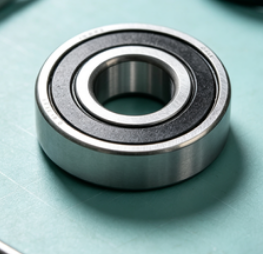
Deep groove ball bearings are typical rolling bearings. The inner ring, outer ring, steel balls and cage form a low-friction support system. The geometry of the raceways enables smooth rolling of steel balls, resulting in low running resistance and high limiting speed, suitable for high-speed, low-noise and low-vibration applications.
In terms of load bearing, deep groove ball bearings are optimized for radial loads and can also carry a certain amount of bidirectional axial loads. When axial force is small and structural space is limited, deep groove ball bearings are usually the preferred option. If the axial load is large or significant overturning moment exists, angular contact ball bearings, tapered roller bearings or paired bearing arrangements should be considered.
Common configurations:
Bearing designations are not random codes. They integrate information including bearing type, size series, bore diameter, structure, seal type and clearance. Reading the designation helps quickly identify the bearing configuration and suitable working conditions.
Designation example: 6204-2RZ/C3
Common suffixes: 2Z stands for double-sided shields; 2RS for double-sided contact seals; C2/C3/C4 represent different radial clearance classes; P6/P5 indicate precision grades. Do not only check the leading size code during selection. Suffixes determine sealing protection, clearance, precision and applicable working conditions.
Proper selection must be matched with correct installation. Axial positioning generally adopts two schemes: double-end positioning and single-end positioning. Double-end positioning delivers higher rigidity for applications demanding precise positioning. Single-end positioning combined with a floating bearing design accommodates thermal elongation and prevents seizure of the shaft system caused by thermal expansion.
Radial fit is also critical. When the inner ring rotates with the shaft under load, an interference fit is normally required for the inner ring. For the outer ring seated in the housing bore, clearance fit, transition fit or interference fit can be selected according to load direction, serviceability and temperature rise. The case shown in the figure adopts transition fit k6 for the inner ring and clearance fit H7 for the outer ring.
Inspection after installation and during service:
The core of deep groove ball bearing selection is to convert actual radial and axial loads into equivalent dynamic load, then calculate the required basic dynamic load rating C based on target service life. The general workflow is as follows:
Core formulas:
Equivalent dynamic load:P = XFr + YFa
Basic dynamic load rating: C = P × [(L10h × 60n) / 10^6]^(1/3)
Life verification: L10h = (C / P)^3 × 10^6 / (60n)
Static load verification: P0 = X0Fr + Y0Fa ≤ C0 / S0
Where: \(F_r\) = radial load; \(F_a\) = axial load; \(X, Y\) = load factors; n = rotational speed; C = basic dynamic load rating; \(C_0\) = basic static load rating; \(S_0\) = static safety factor. In engineering practice, X and Y should not be estimated arbitrarily. They shall be determined from bearing catalogues or standard tables according to \(F_a/F_r\), \(F_a/C_0\) and factor e.
The selection process can follow seven steps: define working parameters, calculate equivalent dynamic load P, work out required C value, tentatively select bearing model by shaft diameter and space constraint, verify life and static load, confirm clearance, seal type and precision grade, and finally check installation fit, lubrication, availability and cost.
Assume a deep groove ball bearing is required to support a motor transmission shaft. Shaft diameter d = 30 mm, radial load \(F_r\) = 3000 N, axial load \(F_a\) = 800 N, speed n = 1500 r/min, target \(L_{10h}\) = 10000 h, ambient temperature, grease lubrication, normal precision grade.
Step 1: Determine load factors. \(F_a/F_r = 800/3000 = 0.267\). Referring to the table in the figure, take X = 0.56, Y = 1.63.
Calculation: Equivalent dynamic load: \(P = 0.56 × 3000 + 1.63 × 800 = 2984\ \text{N} ≈ 3.0\ \text{kN}\) Required basic dynamic load rating: \(C = 2984 × [(10000 × 60 × 1500) / 10^6]^{1/3} ≈ 28.8\ \text{kN}\)
Verification: Life check: \(L_{10h} = (31.2 / 2.984)^3 × 10^6 / (60 × 1500) ≈ 11250\ \text{h} > 10000\ \text{h}\), meets requirement.
Static load check: \(P_0 = 0.6 × 3000 + 1.3 × 800 = 2600\ \text{N}\) \(C_0/S_0 = 19500 / 1.5 = 13000\ \text{N} > P_0\), meets requirement.
Given normal temperature, 1500 r/min, grease lubrication and good dust resistance requirement, 2RS seal is suitable. C3 clearance is selected considering temperature rise and mounting fit. Final selection: 6206-2RS/C3, precision class P0.
Selection summary: Model: 6206-2RS/C3 Dimensions: d = 30 mm, D = 62 mm, B = 16 mm Load ratings: C = 31.2 kN, C0 = 19.5 kN Calculated life: approx. 11250 h, exceeding the required 10000 h Installation recommendation: transition fit k6 for inner ring, clearance fit H7 for outer ring; periodically inspect temperature rise, noise and vibration.
Deep groove ball bearings are standard components, yet selection is far more than matching bore size. Reliable selection must comprehensively consider load, speed, service life, clearance, seal, lubrication, mounting fit and operating environment.
For mechanical beginners, build a standard workflow: list working parameters, calculate P and C, select bearing from catalogues, then verify life, static load and installation. Following this process can prevent many later problems such as overheating, abnormal noise and short service life at the design stage.
Even standard parts in mechanical design cannot be selected merely by experience. Proper selection, correct installation and regular maintenance are the keys to long-term stable operation of deep groove ball bearings.
Fill in the form below and submit. We will receive your email and reply soon.
Enter the code shown in the image to send your email.