
 Customer Service
Pre-sales SILL Agent 6 Xiaoxiao
ID 109501
 +86 574-6319 6918
 manager@sillbearing.com
 Building 32, Zone B, Wanyang Mass Creation City, Henghe Town, Cixi, Ningbo, China.
ID 109501
ID 109503
ID 109505
Date:
1、Deep groove ball bearings are the most widely used rolling bearings. They feature a simple structure and are easy to operate. They are mainly designed to carry radial loads. However, when the bearing radial internal clearance is increased, they exhibit certain properties similar to angular contact ball bearings and can withstand combined radial and axial loads. They can also bear pure axial loads at high rotational speeds where thrust ball bearings are not suitable. Compared with other bearing types of the same size, these bearings have a low friction coefficient and a high limiting speed. Nevertheless, they cannot withstand impact loads and are not suitable for heavy loads.
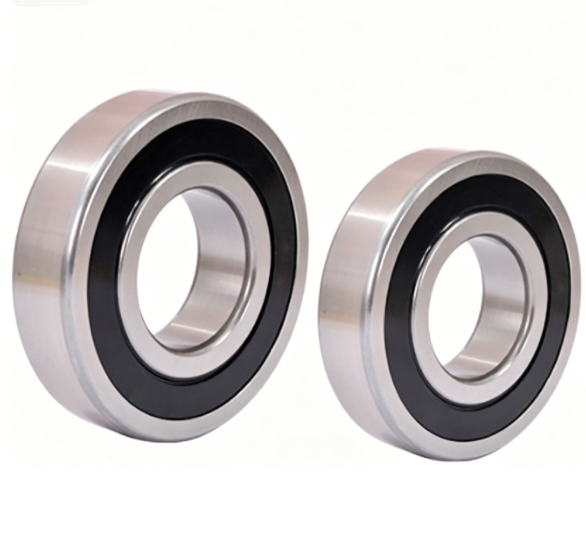
2、After a deep groove ball bearing is mounted on a shaft, it can restrict the axial displacement of the shaft or housing in both directions within its axial internal clearance range, so it can perform axial positioning bidirectionally. In addition, this type of bearing has a certain self-aligning capability. It can operate normally when tilted by 2′~10′ relative to the housing bore, though this will exert a certain impact on bearing service life.
3、Most cages for deep groove ball bearings are stamped steel wave-shaped cages. Large-size bearings mostly adopt machined solid metal cages.
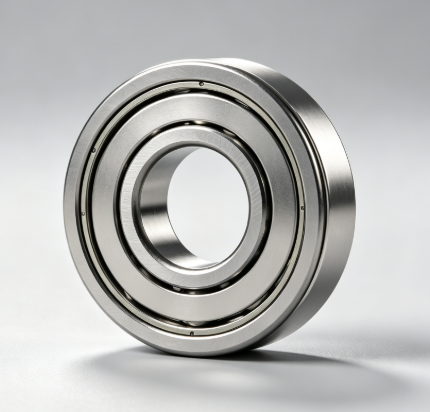
4、Deep groove ball bearings are widely used in automobiles, tractors, machine tools, electric motors, water pumps, agricultural machinery, textile machinery and so on.
With a simple structure, deep groove ball bearings can easily achieve high manufacturing precision compared with other bearing types. Therefore, they are suitable for mass production in series, with relatively low manufacturing cost and extremely broad application. Besides the basic type, deep groove ball bearings have various modified structures.
Open Deep Groove Ball Bearings:They are suitable for high-speed or even ultra-high-speed operation and are highly durable with no frequent maintenance required. This type of bearing features a low friction coefficient, high limiting speed, and a wide range of sizes and configurations. Applied in precision instruments, low-noise motors, automobiles, motorcycles and general machinery, they are the most commonly used bearings in the machinery industry. They mainly bear radial loads and can also carry a certain amount of axial loads.
Sealed Deep Groove Ball Bearings:Standard sealed deep groove ball bearings include contact seal types: RS type or NSK designation DU type (single-side seal), 2RS type or NSK designation DDU type (double-side seal); and non-contact seal types: RZ type or NSK designation V type (single-side seal), 2RZ type or NSK designation VV type (double-side seal).
The performance, grease filling and application of sealed bearings are basically the same as those of shielded bearings. The difference lies in that there is a relatively large gap between the shield and inner ring of shielded bearings, while non-contact sealed bearings have a tiny gap between the sealing lip and inner ring. Contact sealed bearings have no gap between the sealing lip and inner ring, offering superior sealing performance at the cost of slightly increased friction.
For applications with low-noise requirements, small-size deep groove ball bearings of the 60 and 62 series are commonly selected. Low noise and low vibration requirements can be specified at the time of ordering for open bearings, shielded bearings or sealed bearings. China’s JB machinery industry standard specifies the allowable vibration values in low, medium and high frequency bands for vibration grades V1, V2 and V3.
Shielded Deep Groove Ball Bearings:Standard shielded deep groove ball bearings are available in Z type and 2Z type. Z type has a shield on one side, while 2Z or ZZ type has shields on both sides.
Shielded bearings are used in scenarios where independent lubrication is difficult, and it is inconvenient to arrange lubrication pipelines or conduct inspection. Bearings are pre-filled with a fixed quantity and grade of lithium-based grease with both anti-rust and lubricating functions at the manufacturer’s factory. The grease volume filled in each bearing is usually 1/4~1/3 of the effective internal space of the bearing, and the filling amount can be adjusted according to customer requirements.
The pre-filled grease generally ensures bearing operation under working conditions of -40~+120℃. If customers have higher requirements, grease of other grades and properties can be filled as appropriate. Pre-greased shielded bearings can work efficiently for a long time without re-lubrication during service.
Deep Groove Ball Bearings with Snap Ring Groove on Outer Ring:
This type of bearing has a rectangular groove on the outer ring for the snap ring. After the snap ring is installed, the axial fastening of the bearing inside the housing bore can be simplified and the axial dimension of the assembly can be reduced, so as to axially lock the bearing in position.
One-way deep groove ball bearings are also known as one-way clutch bearings. They transmit torque in only one direction. When the driving source drives the driven component, power transmission works in one direction only; if the rotation direction of the driving source reverses (for example, from clockwise to counter-clockwise), power transmission to the driven component stops. One-way rotating ball bearings combine deep groove ball bearings of standard boundary dimensions with built-in special stop blocks and specially structured cages. Featuring powerful functions and compact structure, they are suitable for medium and low torque applications. They are widely used in backstop and feeding mechanisms, such as hydraulic machinery, printing machinery and textile machinery.
Fill in the form below and submit. We will receive your email and reply soon.
Enter the code shown in the image to send your email.